
Provide mothers with financial stability to improve the lives of their children
“I was able to actually take time off after giving birth to heal and learn how to be a mother. The Bridge Project has allowed me to be the mom I’ve always wanted to be.”
-Daniela, Bridge Project Participant
“The Bridge Project has been a constant support, helping me feel seen, secure, and hopeful for my baby’s future. I’m so grateful to be part of a community that truly cares.”
-Ayana, Bridge Project Participant
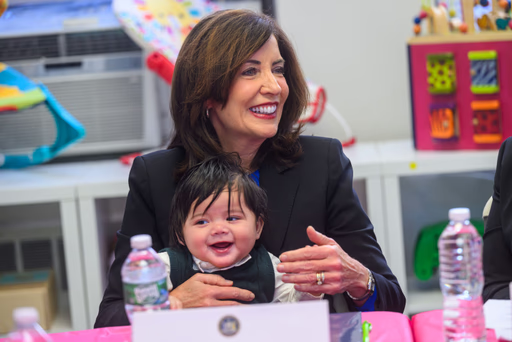
Location: United States, founded in New York City, with sites in New Jersey, Boston, Appalachia, Milwaukee, Connecticut,Indianapolis, Omaha, and Upstate New York
Launched in 2021, the Bridge Project provides low-income mothers with biweekly, unconditional payments and connects them to community resources during pregnancy and the first several years of their child’s life. It now provides regular payments to nearly 4,000 mothers, across multiple regions.
In addition to providing direct payments, the organization has worked with elected officials to advance budget proposals that drive public funding toward unconditional cash payments. In New York, the Bridge Project has catalyzed more than $20 million in public funding for mother and infant cash programs.
A randomized control trial conducted by the University of Pennsylvania’s Center for Guaranteed Income Research found that mothers receiving payments increased their savings by an average of 242%, increased their ability to access outside childcare by 63%, and showed significant improvement in home stability,[1] all factors that contribute to a child’s early learning.
Another study found that 63% of mothers living in transitional housing moved to more permanent housing, 53% saw an increase in food security, and 46% of the cash was used for baby expenses. In Milwaukee, after a year in the program, 31% of moms opted to pursue post-secondary education.[2]
The Bridge Project is conducting further research to determine effects on child health and learning outcomes, but research elsewhere shows strong relationships between improving family income and education levels and better child health and education outcomes.[3,4]
Learn more: https://www.bridgeproject.org/
More ways to help
LIFT provides direct cash transfers and job training to families. FreeFrom gives domestic violence survivors unrestricted cash grants.
For more information on direct cash transfers, see our primer on guaranteed income. For an international organization working to provide direct cash transfers to fill basic needs, see Give Directly.
For more CHIP guidance on improving educational outcomes, see CHIP’s Early School Success, Pathways to Student Success, and High Impact Opportunities to Improve Teaching Quality guides.
Notes
[1] Dor, V. J., & Fogle, H. (2024). The Case for Cash: Early Investment in Moms Improves Prospects for Babies. The Bridge Project. https://drive.google.com/file/d/1fn8epRwy9cewIhElnJJx-R0VJXp4oBgR/view
[2] Dor, V., & Yu, A. (2024). Cash As a Catalyst: Unleashing the Educational Potential of Low-Income Mothers. The Bridge Project. https://drive.google.com/file/d/1AdmGlOhjVsNJxzNAEj4sWSINxh8bW457/view
[3] Oreopoulos, P., Page, M. E., & Stevens, A. H. (2006). The Intergenerational Effects of Compulsory Schooling. Journal of Labor Economics, 24(4), 729–760. https://doi.org/10.1086/506484
[4] Duncan, G. J., Morris, P. A., & Rodrigues, C. (2011). Does Money Really Matter? Estimating Impacts of Family Income on Young Children’s Achievement With Data From Random-Assignment Experiments. Developmental Psychology, 47(5), 1263–1279. https://doi.org/10.1037/a0023875