
Bring health services to people at or near home, and connect those services to larger, preexisting health systems
Nonprofits exemplify this practice by:
- Bringing mental and physical health services close to or into people’s homes
- Training and incentivizing community health workers to deliver services
- Integrating community health into larger or preexisting health systems


More than half of the world’s population lacks access to essential health services.[1] For people in low-income and rural areas, access to healthcare is a particular challenge due to unreliable transportation, language barriers, and distrust of medical professionals.[2]
Globally, access to mental health care is severely limited, particularly in low-income countries that have very few mental health professionals.[3] More than 70% of people with mental illness receive no professional treatment.[4]
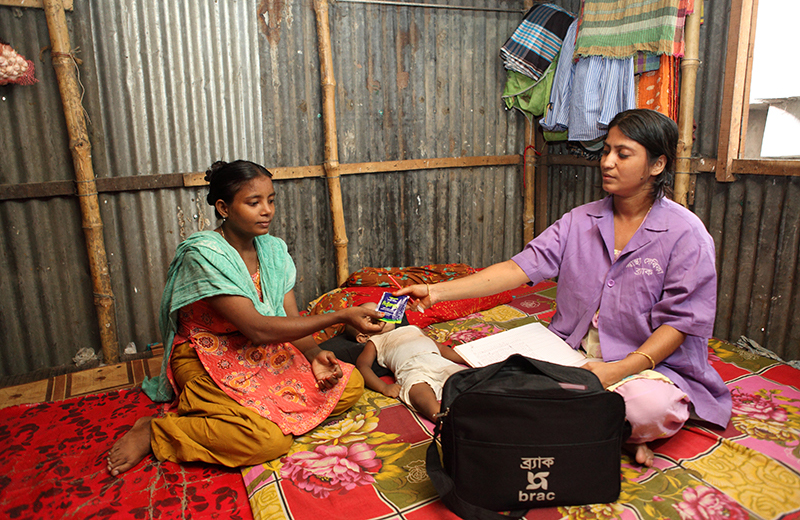
Community health models, which deliver health services and education at the community level, often in people’s homes, are one of the most effective ways to deliver care to hard-to-reach populations.[5]
For example, in Zimbabwe, where there are fewer than 20 psychiatrists for the country’s over 15 million people,[6] Friendship Bench trains community health workers to provide talk therapy in local spaces. In the United States, where many lack access to healthcare facilities,[7] Changent provides free physical and mental health services to children and their families in their homes.
Community health programs that train community health workers (CHWs), people who provide basic health and medical care to their own communities, are the most effective when they provide training, adequate supervision, and incentives (monetary or otherwise).[8, 9, 10]
For example, BRAC’s community health worker program trains local women embedded in their communities to be CHWs, providing primary and preventative care through home visits and referring cases to clinics as needed. Their CHWs receive regular supervision and earn income by selling health-promoting products.
Successful community health programs often build on and engage with preexisting health systems and stakeholders.[11] Partners can include local hospitals to refer more complex medical cases; local or national governments to leverage preexisting public efforts; other nonprofits working in the community; and people like midwives who already provide care services outside of formal hospital settings. Impact Global Health Alliance – Guatemala, which builds accessible birthing centers in rural Guatemala, is an example of how to enlist and train local midwives and mothers.
What follows are more detailed profiles of these four organizations. All are real-world examples of how nonprofits implement these best practices. For more resources on supporting health, both physical and mental, see CHIP’s Community-Based Approaches to Health and Health in Mind: A Philanthropic Guide to Mental Health and Addiction.
Notes
[1] World Health Organization. (2023, September 18). Billions left behind on the path to universal health coverage. https://www.who.int/news/item/18-09-2023-billions-left-behind-on-the-path-to-universal-healthcoverage, World Health Organization. (2025, March 26). Universal health coverage (UHC). Retrieved August 4, 2025, from https://www.who.int/news-room/fact-sheets/detail/universal-health-coverage-(uhc)
[2] Partners in Health. (n.d.). The Role of Community Health Workers in the U.S. | Partners In Health. Retrieved August 4, 2025, from https://www.pih.org/article/role-community-health-workers-us
[3] Landis, M. (2022, May 12). What Do Mental Health Services Look Like Around the World? Project HOPE | Advancing Global Health & Saving Lives. https://www.projecthope.org/news-stories/story/what-do-mentalhealth-services-look-like-around-the-world/
[4] Henderson, C., Evans-Lacko, S., & Thornicroft, G. (2013). Mental illness stigma, help seeking, and public health programs. American journal of public health, 103(5), 777–780. https://doi.org/10.2105/AJPH.2012.301056
[5] Bresnahan, B. W., Vodicka, E., Babigumira, J. B., Malik, A. M., Yego, F., Lokangaka, A., Chitah, B. M., Bauer, Z., Chavez, H., Moore, J. L., Garrison, L. P., Swanson, J. O., Swanson, D., McClure, E. M., Goldenberg, R. L., Esamai, F., Garces, A. L., Chomba, E., Saleem, S., …Nathan, R. O. (2021). Cost estimation alongside a multi-regional, multi-country randomized trial of antenatal ultrasound in five low-and-middle-income countries. BMC Public Health, 21, 952. https://doi.org/10.1186/s12889-021-10750-8
[6] Mafundikwa, I. (2024, January 10). Friendship Bench: Zimbabwe doctor turns to grandmothers to treat depression. Al Jazeera. https://www.aljazeera.com/features/2024/1/10/how-counsellor-grandmothers-ofzimbabwe-are-averting-a-mental-health-crisis
[7] Guo, J., Hernandez, I., Dickson, S., Tang, S., Essien, U. R., Mair, C., & Berenbrok, L. A. (2022). Income disparities in driving distance to health care infrastructure in the United States: A geographic information systems analysis. BMC Research Notes, 15, 225. https://doi.org/10.1186/s13104-022-06117-w
[8] Peretz, P. J., Matiz, L. A., Findley, S., Lizardo, M., Evans, D., & McCord, M. (2012). Community Health Workers as Drivers of a Successful Community-Based Disease Management Initiative. American Journal of Public Health, 102(8), 1443–1446. https://doi.org/10.2105/AJPH.2011.300585
[9] Haines, A., Sanders, D., Lehmann, U., Rowe, A. K., Lawn, J. E., Jan, S., Walker, D. G., & Bhutta, Z. (2007). Achieving child survival goals: Potential contribution of community health workers. The Lancet, 369(9579), 2121–2131. https://doi.org/10.1016/S0140-6736(07)60325-0
[10] Kowalczyk, M., Yao, N., Gregory, L., Cheatham, J., DeClemente, T., Fox, K., Ignoffo, S., & Volerman, A. (2024). Community health worker perspectives: Examining current responsibilities and strategies for success. Archives of Public Health, 82(1), 94. https://doi.org/10.1186/s13690-024-01313-5
[11] Ibid.