
A first look at a new and timely framework to help funders address today’s “polycrisis,” from climate disasters to economic shocks
Communities are facing multiple crises, including environmental disasters, economic shocks, and loss of trust in public institutions. These interconnected crises – sometimes referred to as a “polycrisis” – require responses that not only address immediate needs but also strengthen the underlying systems that enable communities to be resilient in the face of threats.
This framework introduces a way for donors and institutional grantmakers to consider investments that increase community resilience. Increasing community resilience mitigates the most severe harm caused by crises, can help prevent future ones, and starts building the long-term strength communities need to thrive amid ongoing change. The framework’s strategic focus areas are core elements that enable communities to withstand and recover from disruptions.
Why this, why now?
According to the United Nations, in 2025, 300+ million people in the United States and around the world needed humanitarian assistance and protection, representing almost 30 million more people than at the start of 2023. More than 1 in 73 people are forcibly displaced worldwide, with internal displacement reaching its highest ever level at 71.1 million people. Acute food insecurity affects 258 million people across 58 countries.
Multiple, interconnected factors, including environmental disasters, armed conflict, economic shocks, and shifts in government policy, are contributing to this human toll.
Community Resilience Framework:
How funders can help communities withstand crises
Funders can strengthen community resilience by investing in one or more of these five strategic focus areas. Organizations working in these areas enable communities to withstand, adapt to, and recover from crises. The central element, Community Engagement and Responsive Governance, underpins and enables progress across all other strategic focus areas.
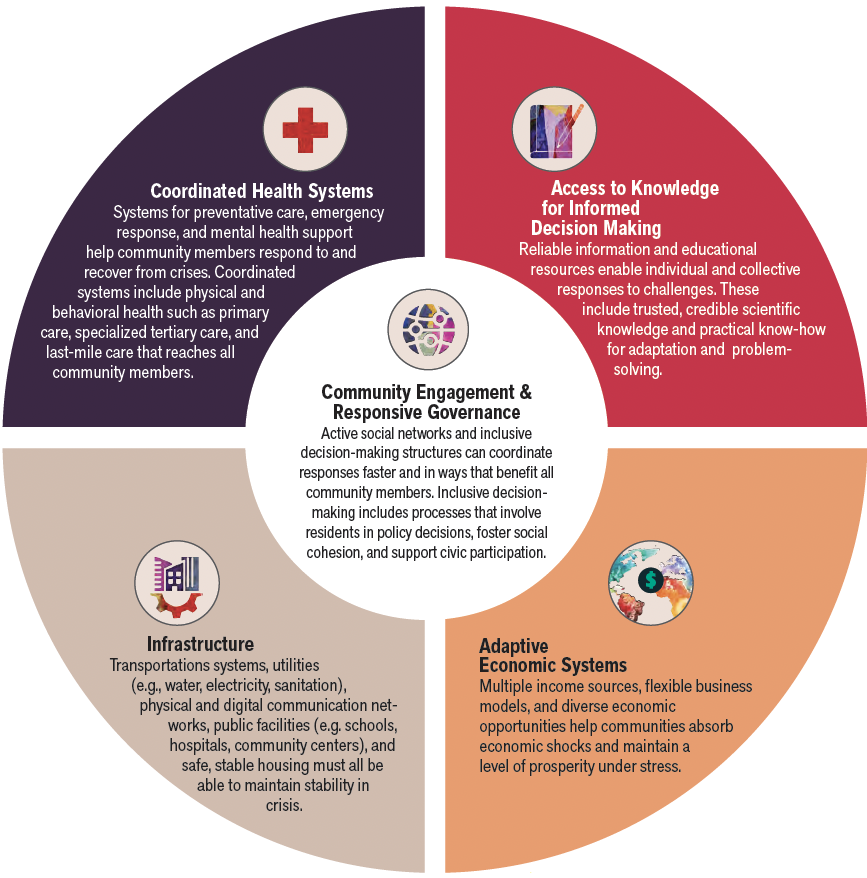

Coordinated Health Systems
Systems for preventative care, emergency response, and mental health support help community members respond to and recover from crises. Coordinated systems include physical and behavioral health such as primary care, specialized tertiary care, and last-mile care that reaches all community members.

Access to Knowledge for Informed Decision Making
Reliable information and educational resources enable individual and collective responses to challenges. These include trusted, credible scientific knowledge and practical know-how for adaptation and problem-solving.

Adaptive Economic Systems
Multiple income sources, flexible business models, and diverse economic opportunities help communities absorb economic shocks and maintain a level of prosperity under stress.

Infrastructure
Transportations systems, utilities (e.g., water, electricity, sanitation), physical and digital communication networks, public facilities (e.g. schools, hospitals, community centers), and safe, stable housing must all be able to maintain stability in crisis.

Community Engagement & Responsive Governance
Active social networks and inclusive decision-making structures can coordinate responses faster and in ways that benefit all community members. Inclusive decision-making includes processes that involve residents in policy decisions, foster social cohesion, and support civic participation.
Framework in Practice
Here, we highlight how some of the nonprofits profiled in High Impact in Practice illustrate ways that philanthropy can increase community resilience.
For example, BuildUp Nepal and Lower Sioux Indian Community Hemp Program and Housing Project address two strategic focus areas simultaneously: Infrastructure and Adaptive Economic Systems. Both ensure safer, more affordable, and more environmentally resilient housing, while using abundant, locally-sourced building materials to create new livelihoods for community members.
BRAC, Changent, Friendship Bench, and Impact Global Health Alliance- Guatemala fill gaps and extend care in ways that contribute to the kind of Coordinated Health Systems needed to reach all community members.
National Zoning Atlas is an example of how providing Access to Knowledge and Informed Decision Making leads to needed reforms. In this case, data was used to persuade legislators to enact reforms that increased the supply of affordable housing.
By equipping participants with the resources to solve the problems that they prioritize, EcoRise and the Bridge Project model the kind of connection and inclusive decision-making that characterizes Community Engagement and Responsive Governance.